 English

Product Category
-
Cable Tray Roll Forming Machine Series
-
Shelving Production Line
-
Solar Mounting Structure Equipment Series
-
Purlin Quick-Change Equipment Series
-
Corrugated Sheet Roll Forming Line
-
Door and Window Frame Roll Forming Line
-
Automotive Profile Roll Forming Equipment Series
-
Steel Keel Cold Roll Forming Machine
-
High-speed Guardrail Roll Forming Machine
NEW Category
Contact us
Technological innovation drives industrial upgrading and promotes the development of automotive lightweighting.
Technical upgrades lead industry development.
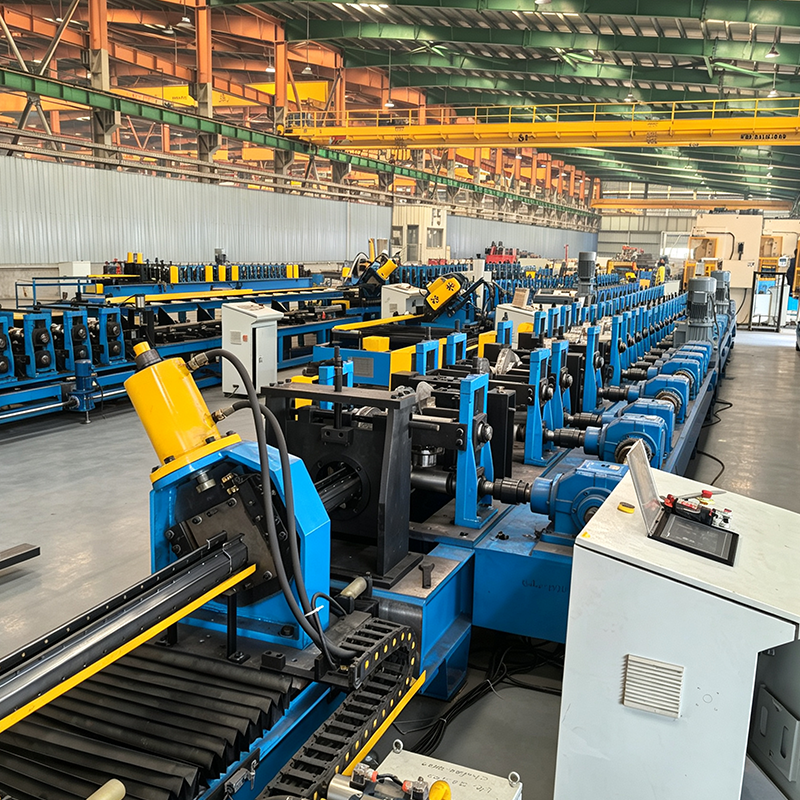
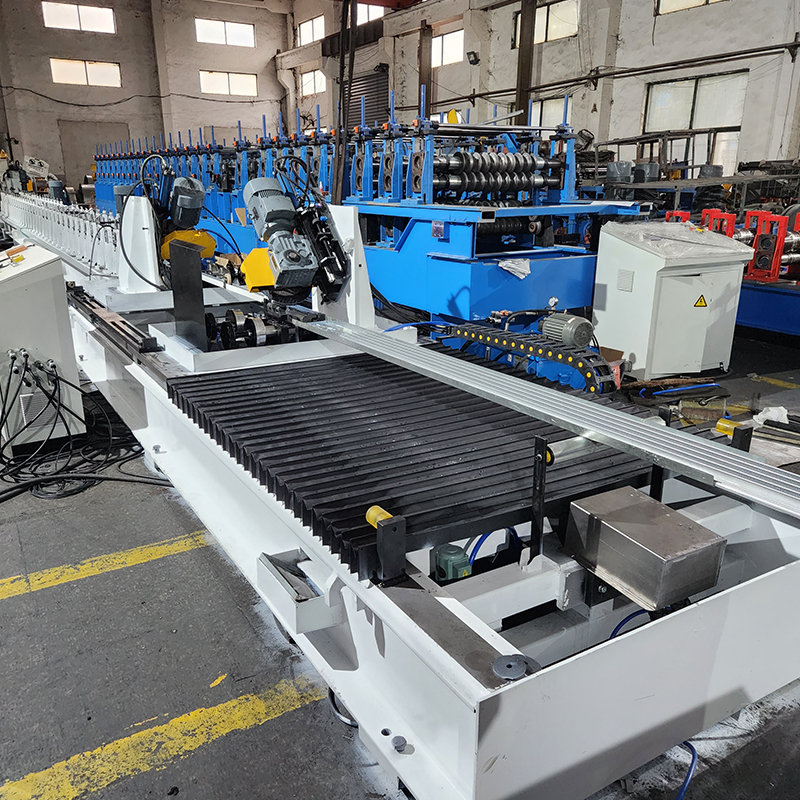
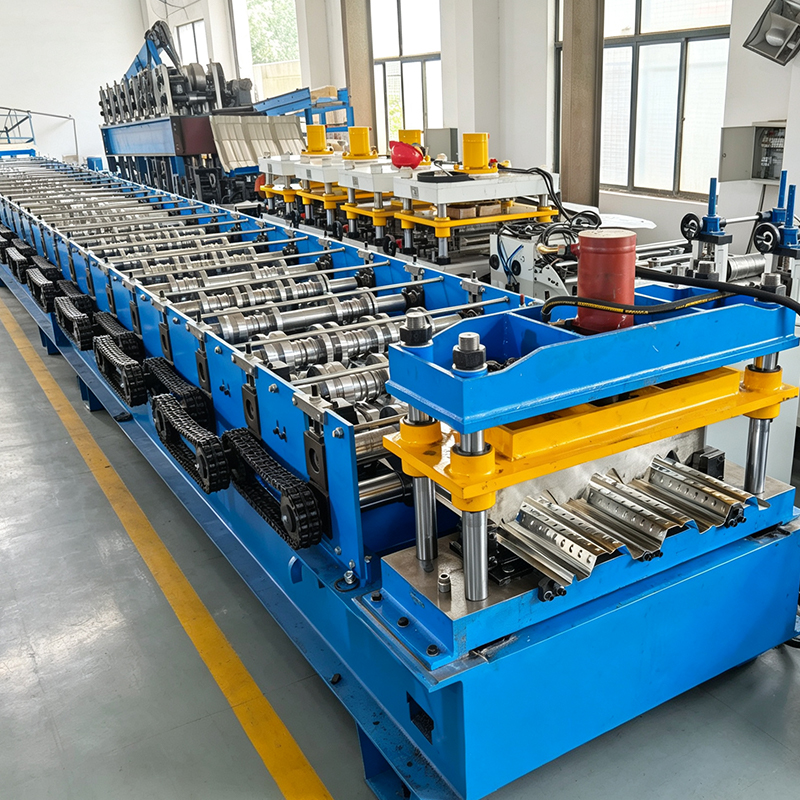
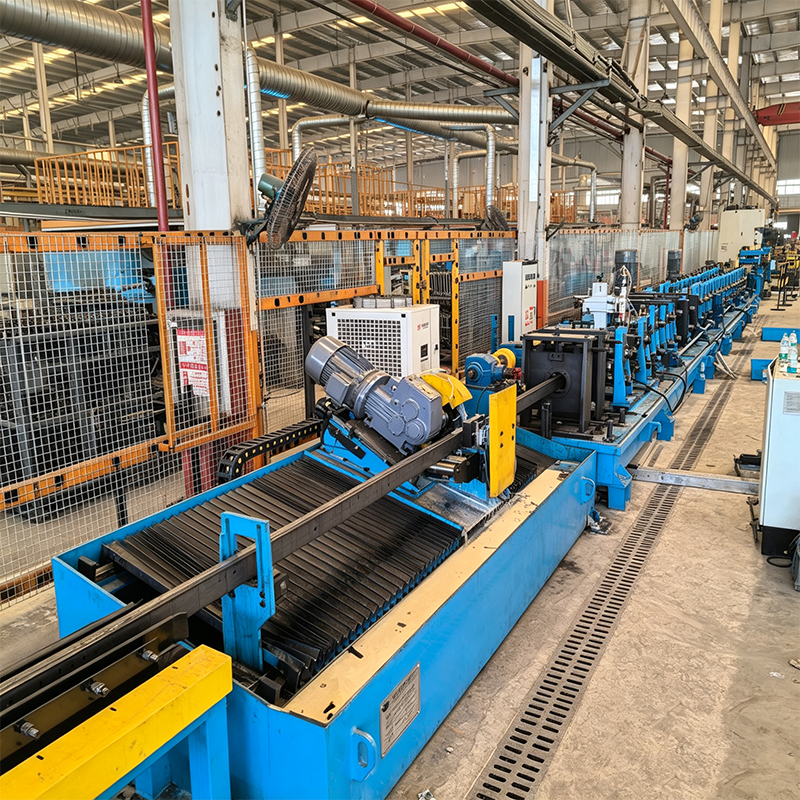
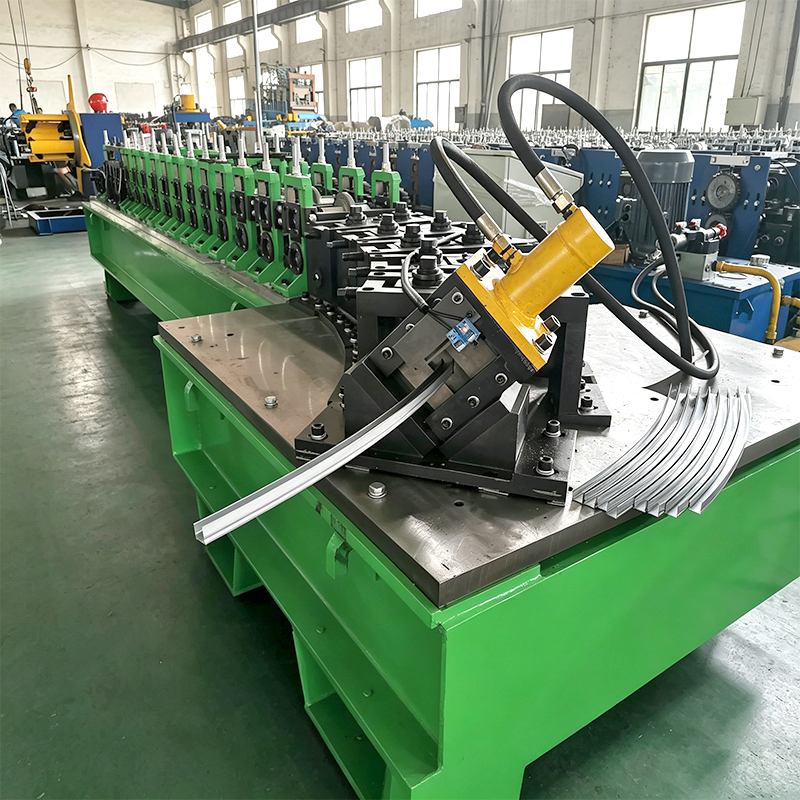
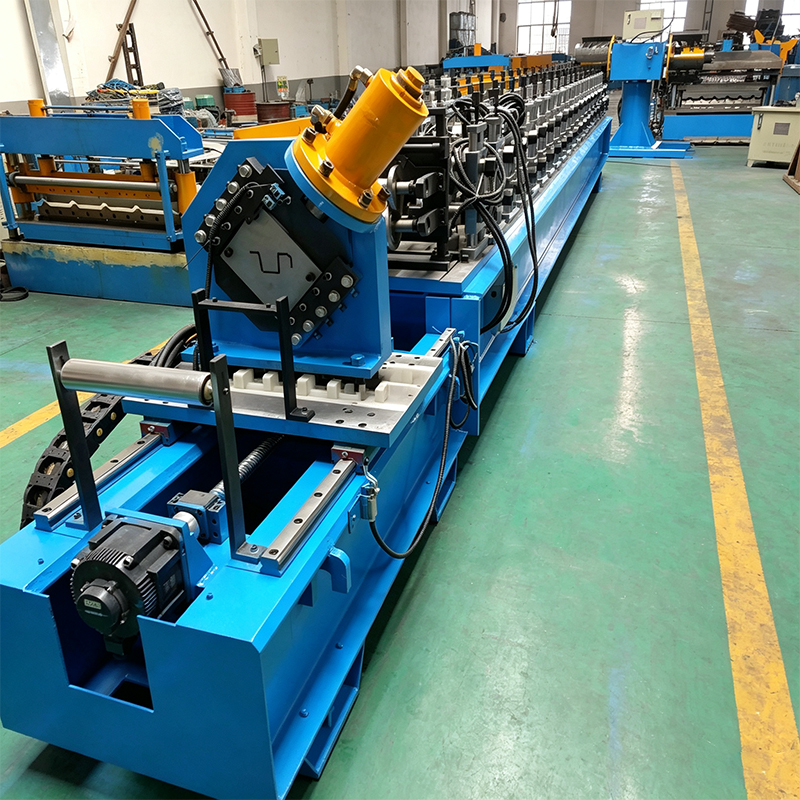
The modern cold bending forming machine for automotive profiles has undergone a comprehensive upgrade from traditional hydraulic drive to servo drive technology. The servo motor-driven forming equipment not only improves positioning accuracy but also significantly reduces energy consumption and noise levels, with maintenance costs dropping sharply. In terms of forming accuracy, the axial repeat positioning accuracy of advanced equipment can reach -0.01 mm, and the upper wheel positioning accuracy reaches 0.02mm, which can meet the strict dimensional tolerance requirements of automotive structural components.
The half-diameter bending capability is a significant technological breakthrough in current automotive profile cold bending forming machines. Through the four-axis positioning system and ball screw closed-loop variable frequency motor control system, the equipment can achieve one-time forming of irregular shapes such as egg-shaped and elliptical, minimizing deformation during the forming process to the greatest extent. This technological breakthrough makes it possible to achieve efficient production of complex structural components such as car window frames and body reinforcement beams.
Intelligentization and automation are deeply integrated.
Against the background of Industry 4.0, automotive profile cold bending forming machines are accelerating their evolution towards intelligence. The PLC control system is equipped with a user-friendly touch screen interface, supports multi-language operation, can store multiple product formulas, and enables rapid switching of different specifications of profiles. The intelligent parameter storage system significantly reduces the changeover time, and some advanced equipment can complete the mold change in 30 minutes, with an efficiency increase of 70% compared to traditional equipment.
Full-process automation operations have become the industry standard. From feeding, guiding, and forming to welding, cutting, and packaging, the entire production line can operate without human intervention, with only 1-2 people on duty per production line. The integration of the automatic stacking system further reduces manual intervention, ensuring the neat stacking and efficient turnover of finished profile products.
Continuous breakthroughs in lightweight material processing capabilities
Facing the increasing demand for high-strength steel and aluminum alloy materials in the automotive industry, the technical adaptability of cold bending forming equipment is constantly improving. Modern equipment can handle materials such as strengthened steel and galvanized steel with thickness ranges of 0.3-5.0mm. The rollers use Cr12MoV mold steel after vacuum heat treatment, with a hardness of HRC58-62, ensuring no cracking during high-strength steel forming.
To address the industry pain point of high-strength steel forming prone to rebound and cracking, equipment manufacturers have optimized the roller curve design and adopted multi-pass progressive roller pressing technology to effectively solve this technical problem. The section size tolerance can be stably controlled within ±0.2mm, the hole position accuracy is fine to ±0.1mm, and the product qualification rate can reach over 99.5%.
The market prospect is broad.
According to industry research, the cold bending forming machine market is experiencing a rapid growth period. In the automotive manufacturing field, with the explosive growth of the new energy vehicle industry, the production demand for core structural components such as battery trays and body reinforcement beams has significantly increased. The widespread application of lightweight materials and the increase in complex pipe component structures continue to drive the demand for advanced cold bending forming equipment.
Industry insiders point out that in the future, cold bending forming technology will evolve towards multi-axis linkage and flexible manufacturing. The implementation of artificial intelligence and machine vision technologies will give equipment the ability to perform online quality inspection, and digital twin technology will be applied to forming process simulation, further reducing trial-and-error costs and accelerating new product development speed. Equipment manufacturers with the ability to provide customized solutions will gain a competitive advantage in this round of industrial upgrading.
NEXT:No next article
Interested in cooperation or have questions?
-
 No. 1, Yudong Road, Yeqi Industrial Park, Huishan District, Wuxi City, Jiangsu Province, China
 -
 +86-13001365711
 -

- Cable Tray Roll Forming Machine Series
- Shelving Production Line
- Solar Mounting Structure Equipment Series
- Purlin Quick-Change Equipment Series
- Corrugated Sheet Roll Forming Line
- Door and Window Frame Roll Forming Line
- Automotive Profile Roll Forming Equipment Series
- Steel Keel Cold Roll Forming Machine
- High-speed Guardrail Roll Forming Machine
Copyright © Wuxi Yanwu Xinhui Technology Co., Ltd. All Rights Reserved.
