I. Equipment Overview
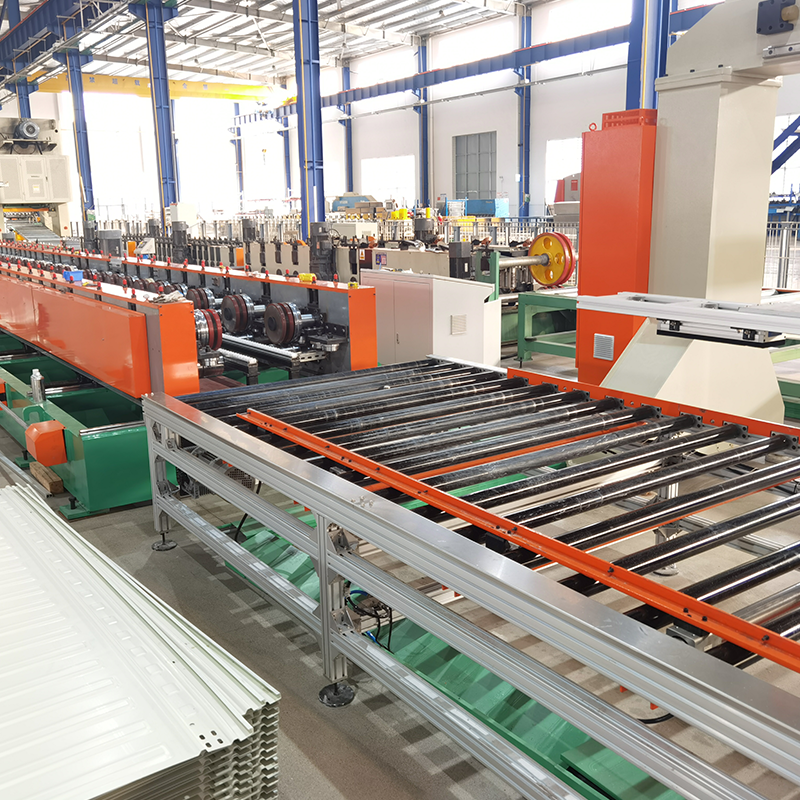
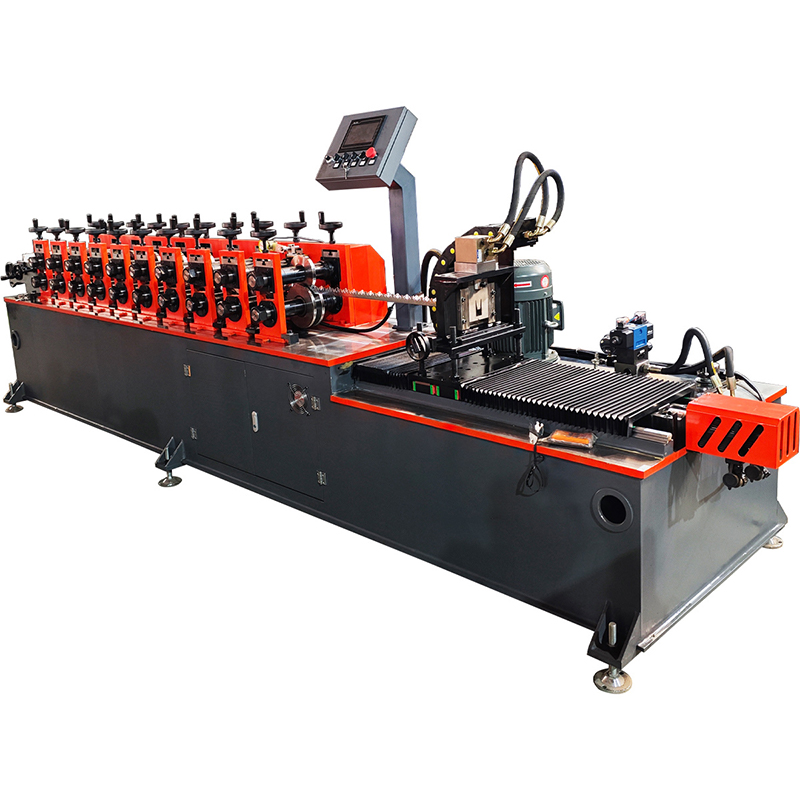
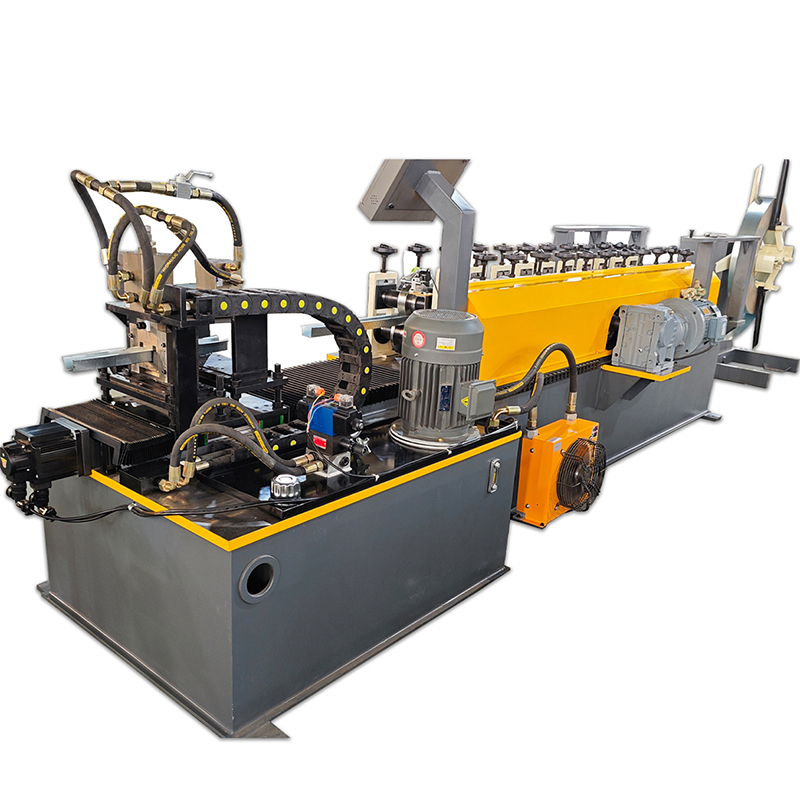
The Antique-style Glazed Tile Roll Forming Machine is specialized cold-roll forming equipment designed to produce metal antique-style glazed tiles (often made from color-coated steel or aluminum). Using color-coated steel or aluminum coils as raw materials, the machine employs a precision roll-forming process to transform modern metal into roofing materials that possess the rustic, elegant appearance of traditional clay glazed tiles. Through a continuous roll-forming process, the equipment automatically executes the entire production cycle—including uncoiling, guided feeding, protective film application, electric slitting, roll forming, stamping, cutting, and discharging—to yield finished antique-style glazed tiles in a single pass.
Coils of steel are transformed via precision roll forming into antique-style glazed tiles featuring intricate textures—reminiscent of hand-carved craftsmanship—in a matter of seconds. The entire line utilizes a PLC-based fully automatic control system with a touchscreen HMI, ensuring a continuous, automated workflow from uncoiling to the discharge of finished products. The equipment accommodates various metal sheets, such as color-coated steel and galvanized steel, with thicknesses ranging from 0.45 mm to 0.55 mm and an input width of approximately 1220 mm (subject to the actual width of the test material). It is capable of producing multiple tile specifications, including models 800, 828, 840, 860, and 1050. Requiring only one operator, this line serves as core equipment for manufacturers seeking to achieve automated, standardized, and large-scale production of antique-style roofing materials.
These antique-style glazed tiles perfectly blend traditional tile aesthetics with modern color-coated steel technology, resulting in a product that is dignified, elegant, visually appealing, and sophisticated. The tiles produced by this equipment are characterized by their beautiful appearance, rustic elegance, refined design, and high quality. They are widely used in the construction and exterior decoration of garden-style factories, tourist attractions, pavilions, hotels, villas, exhibition halls, resorts, and residential homes.
II. Core Advantages and Selling Points
(1) Multi-profile Capability and Flexible Production
This is the core advantage distinguishing this equipment from conventional production lines limited to a single specification.
Traditional glazed tile equipment is typically customized for a single tile profile; switching products requires replacing the entire mold set, which is time-consuming and costly. This equipment utilizes a modular mold design and adjustable forming technology, allowing a single machine to produce various tile specifications, such as the 800, 828, 840, 860, and 1050 models. Certain models can also switch to producing resin-imitation tiles to meet the decorative requirements of diverse projects. Specification changes are accomplished via a quick mold-change system; no specialized technicians are required, as standard operators can perform the switch, significantly enhancing equipment utilization rates.
(2) Cast-Steel Arch Frame + Gearbox Drive: High Rigidity, Precision, and Durability
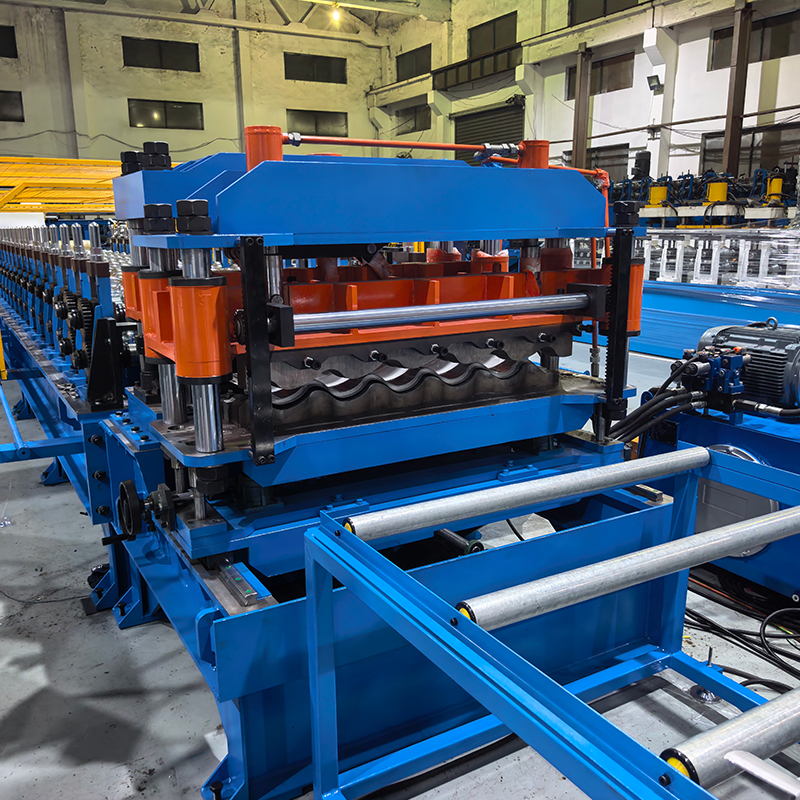
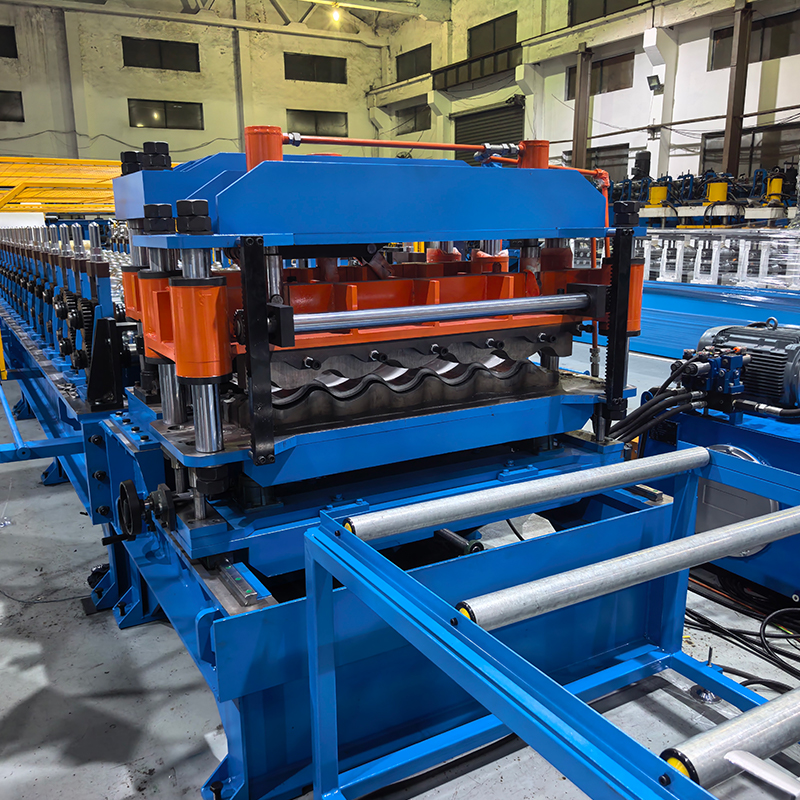
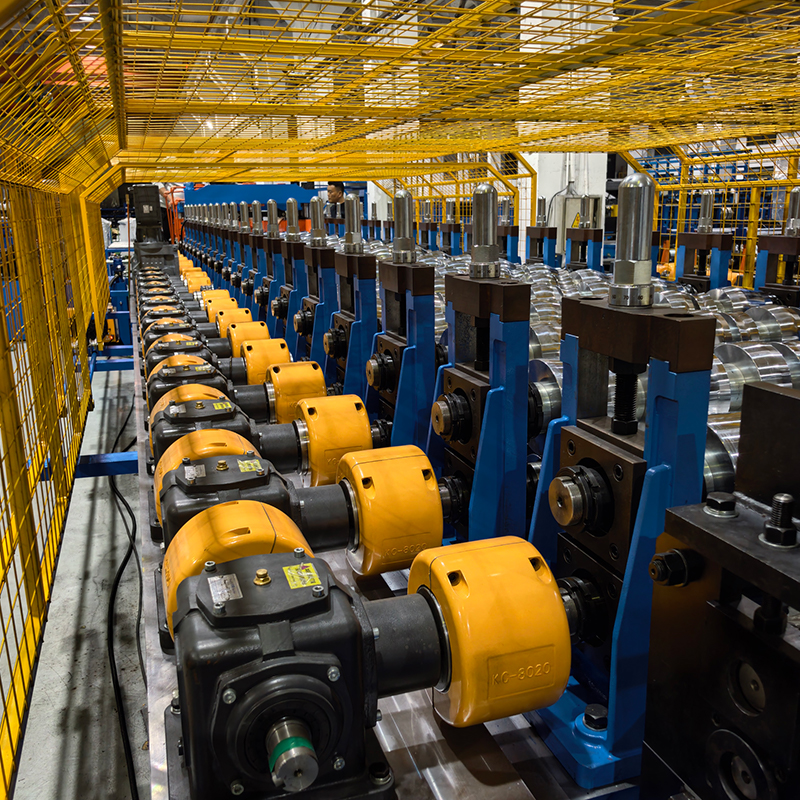
The main forming unit features a cast-steel arch frame structure, utilizing 19 pairs of "110" model arch frames. These cast frames undergo tempering treatment, offering superior rigidity and deformation resistance, which ensures stable, high-intensity operation over long periods.
The drive system employs a gearbox configuration, utilizing 18 units of the "140" model. Compared to chain drives, gearbox drives offer significant advantages, including smooth operation, low noise, high precision, and a long service life. The gearboxes are sourced from the reliable "Maxter" (Ningbo) brand. The transmission setup combines chain linkage with protective housing, ensuring both operational reliability and safety.
(3) High-Strength Frame, Precision Machined on Gantry Machining Centers
The frame assembly comprises the guiding mechanism and the main frame structure.
The main frame is constructed from 400×200 H-beams, with 25mm-thick steel plates welded onto the mounting surfaces; the assembly is then finished on a gantry machining center. This H-beam and thickened-plate design ensures exceptional rigidity and resistance to deformation. Machining in a single setup on a gantry machining center guarantees the parallelism and perpendicularity of all mounting surfaces, laying a solid foundation for the high-precision operation of the entire production line.
(4) Guided Infeed Rack for Precise Positioning
Guided Infeed Rack Structure: Lateral guide rollers (left and right) are installed at the main machine's infeed opening. During operation, the raw sheet material passes through these guides before entering the main machine, ensuring correct alignment with the roll-forming system. The guide position is adjustable via a manual screw mechanism; the left and right guides can be adjusted independently to accommodate sheets of varying widths.
(5) Film Laminating Device for Surface Finish Protection
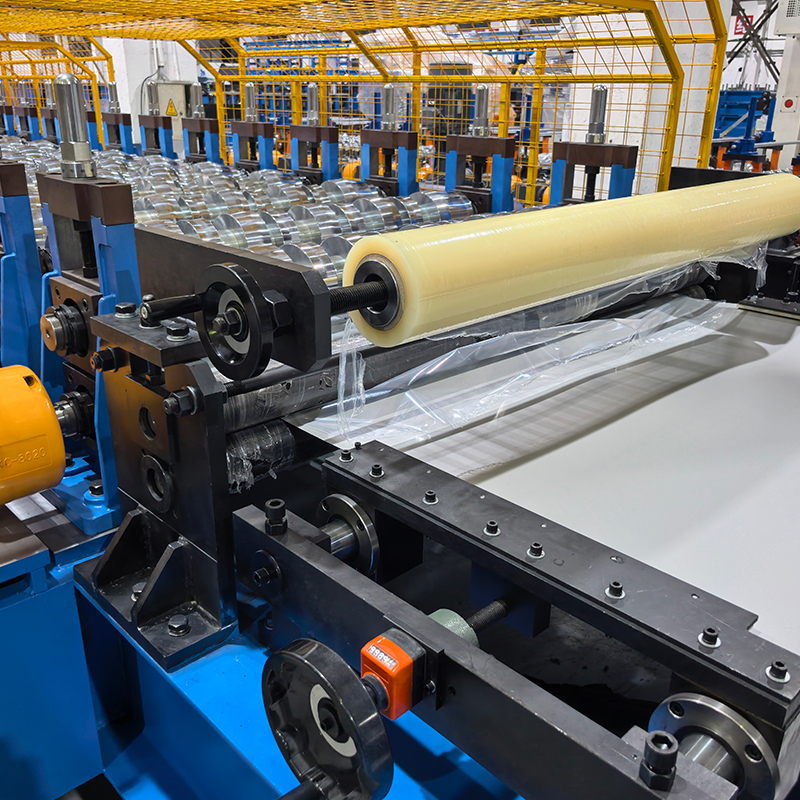
This device is designed to enhance the forming quality of the sheet. A laminating rack is installed at the infeed guide section, consisting primarily of a film storage unit and a pressing unit.
Film Storage Unit: Comprises a mandrel and adjustable end plates. The film roll is mounted on the mandrel, with the end plates adjusted to secure it.
Pressing Unit: Consists of rubber rollers (approximately 90mm in diameter) positioned at the first forming station; both the upper and lower rollers are passive (driven by the movement of the sheet). As the sheet passes through the rotating rubber rollers, it is pulled forward while the film is smoothly applied to the steel surface. The rollers can be adjusted to the appropriate position via a screw mechanism to suit different sheet thicknesses.
The laminating device effectively prevents scratches and abrasion to the sheet's surface coating during roll forming and punching, ensuring the gloss and color integrity of the finished tile surface.
(6) 19-Station Precision Roll Forming for a Flawless, Flat Surface
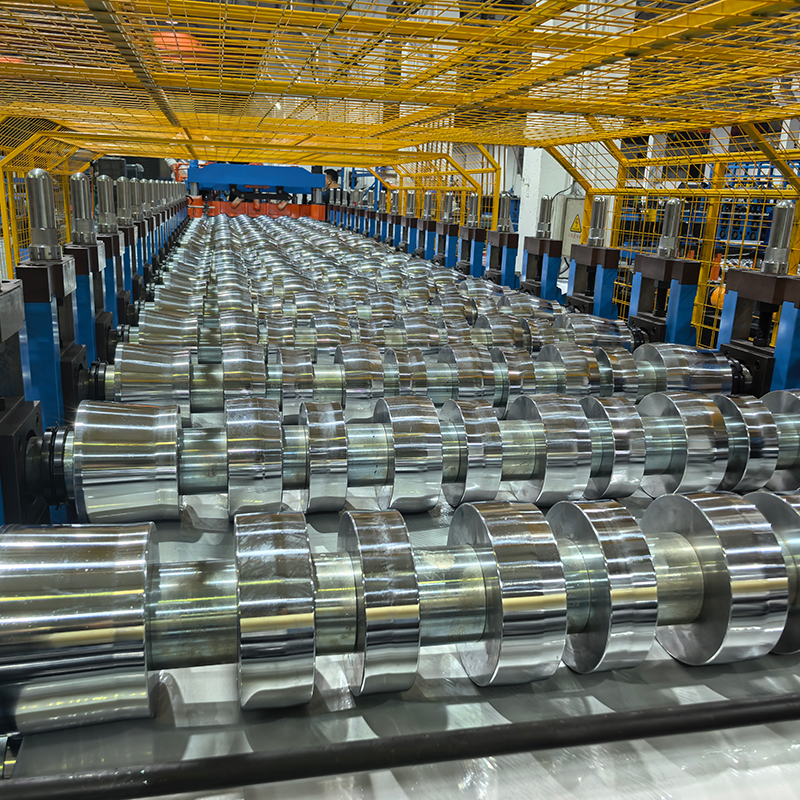
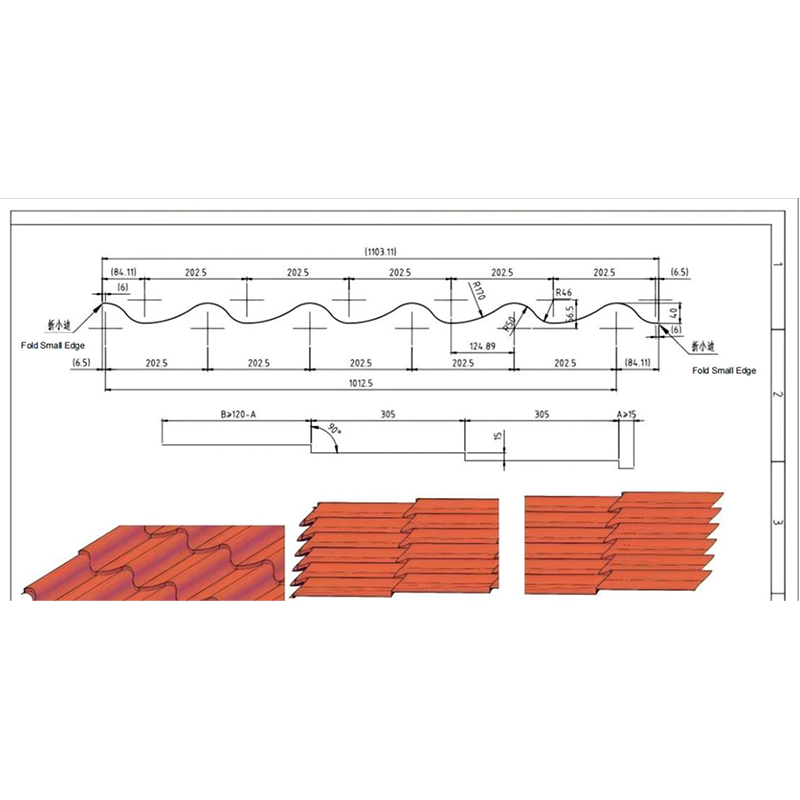
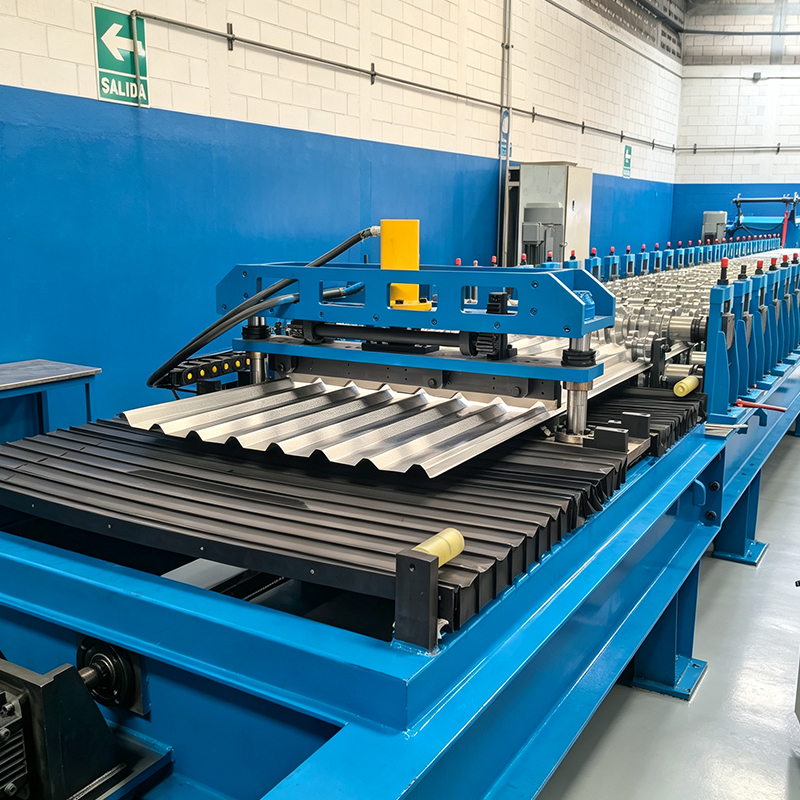
Utilizes a 19-station precision roll-forming process. The metal sheet undergoes multi-stage, progressive cold-bending to gradually form the curved corrugations and "bamboo-joint" textures characteristic of traditional glazed tiles. Forming Unit: Composed of bearing housings, roller sets, and forming shafts.
Bearing Brands: Uses only genuine HRB, ZWZ, and LYC bearings; ensures smooth operation and long service life.
Roller Material: 45# steel, chrome-plated and polished; chrome plating thickness approx. 0.03mm; hardness HRC 53–54.
Roller Machining: CNC-machined to ensure precise circular and radial runout control.
Shaft Material: 40Cr steel with quenched and tempered treatment (HB 220–260); shaft diameter Φ80mm.
Spacers: Machined from thick-walled tubing (min. 5mm) to minimize shaft runout and ensure geometric tolerances; increased contact surface area with rollers; clearance fit between the inner bore and the shaft.
Small-Edge Bending Process: Includes a specific small-edge bending step to effectively prevent bulging at the edges of the finished panel, ensuring a flat and aesthetically pleasing surface.
Synchronized Roller Speed: Uniform rotational speed across forming rollers prevents stretching or compression during the forming process, significantly enhancing the quality of the antique-style color-coated steel glazed tiles. The resulting panel surface is flat, free of wrinkles, and devoid of paint scratches.
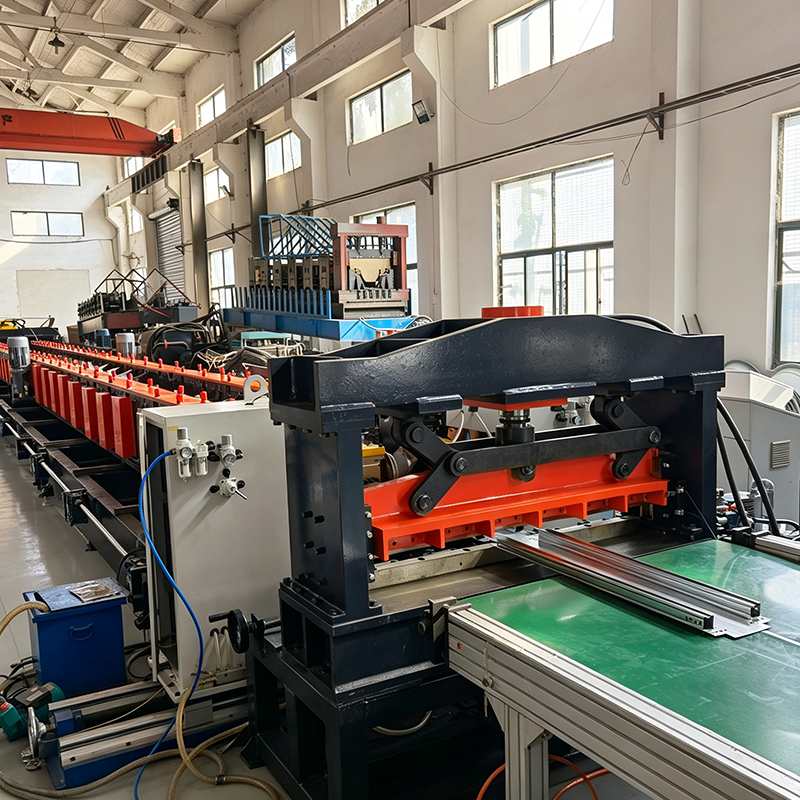
(7) Integrated Punching and Cutting: Single-stage forming process.
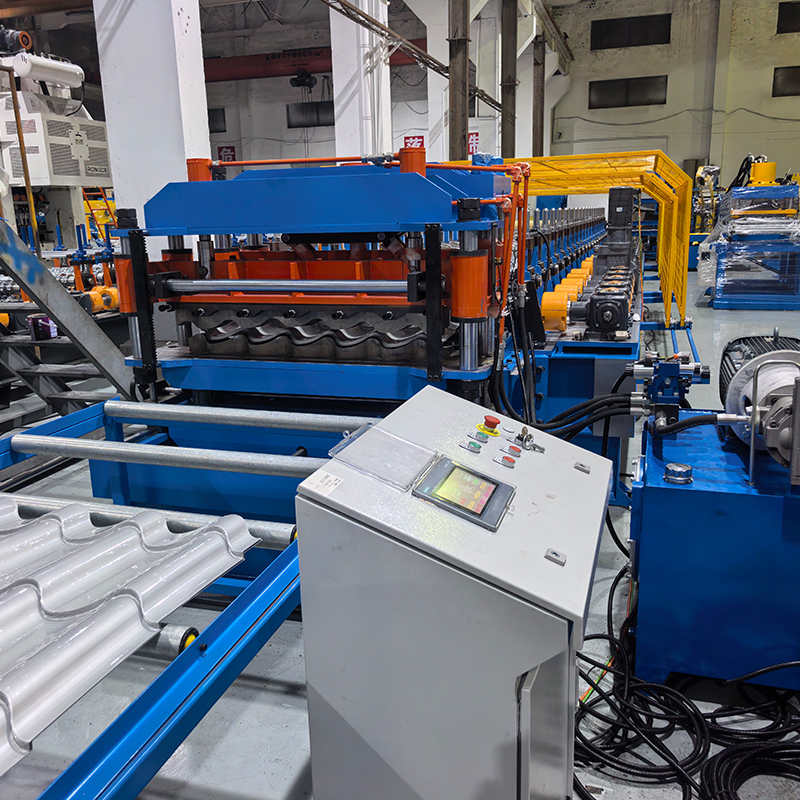
The equipment integrates the punching/forming unit with the cutting unit. The punching section uses a hydraulic cylinder to drive the die vertically, pressing the roll-formed sheet into evenly spaced tile corrugations; the cutting section uses a hydraulic cylinder to drive the blade for fixed-length cutting. Roll forming, punching/forming, and fixed-length cutting are executed seamlessly in a single, multi-process machine.
Forming Machine Motor: 7kW (Siemens servo motor) for precise, controllable power. Gearbox: Guomao brand, ensuring reliable quality. Line speed: 0–5 m/min; forming speed: 15–25 m/min. Length precision: ±1.5mm; ensures uniform product dimensions and consistent quality.
(8) High-Efficiency Production and Industry-Leading Capacity
The integrated production line automates the entire process, including uncoiling, film lamination, forming, punching, and cutting. Fully automated operation requires only one operator, delivering efficiency several times higher than traditional production methods.
(9) Fully Automated PLC Control and Intelligent Production
Featuring full PLC control and a touchscreen HMI, the system enables digital management of the entire process. A variable frequency drive (VFD) operates the main motor, while the system also controls the hydraulic station motor and solenoid valves. Operators can configure parameters—such as production speed, cut length, and output quantity—via the interface with a single touch. Multiple production tasks can be pre-programmed for continuous automated operation. The system includes real-time monitoring and fault early-warning capabilities, automatically triggering alarms and displaying the cause of any malfunction. Operators can become fully proficient after just 1–2 days of training.
III. Technical Parameters
Item Parameter
Applicable materials Color-coated steel sheet, galvanized sheet, etc.
Material thickness 0.45–0.55 mm
Raw material width Approx. 1220 mm (subject to actual test material width)
Frame assembly Guide unit + frame; main frame made of 400×200 H-beam; 25mm steel plate welded to mounting surface; machined on gantry machining center
Inlet guide rack Left/right side guide rollers; manual screw adjustment; independently adjustable
Forming machine structure Cast arch-style structure (Arch model 110, 19 pairs)
Transmission system Gearbox drive (Model 140, 18 units, Ningbo Maxter brand); chain connection + protective housing
Number of forming stations 19 stations
Bearing brand Genuine HRB / ZWZ / LYC
Roller material 45# steel, chrome-plated and polished; chrome thickness 0.03 mm (HRC 53–54)
Roller machining method CNC turning; ensures control of circular runout and radial runout
Shaft material 40Cr, quenched and tempered (HB 220–260)
Shaft diameter Φ80 mm
Spacer sleeves Machined from thick-walled tubing (min. 5 mm wall thickness) to ensure geometric tolerances
Forming machine motor power 7 kW (Siemens servo motor)
Forming machine reducer Guomao brand
Forming machine line speed 0–5 m/min
Forming speed 15–25 m/min
Film laminating unit Rubber roller diameter approx. 90 mm; located at the first station; passive upper/lower rollers; screw adjustment
Small-edge folding process Includes small-edge folding to prevent bulging on the edges of the finished panel
Cut-to-length accuracy ±1.5 mm
Control system Fully automatic PLC control
Operators 1 person
IV. Production Process
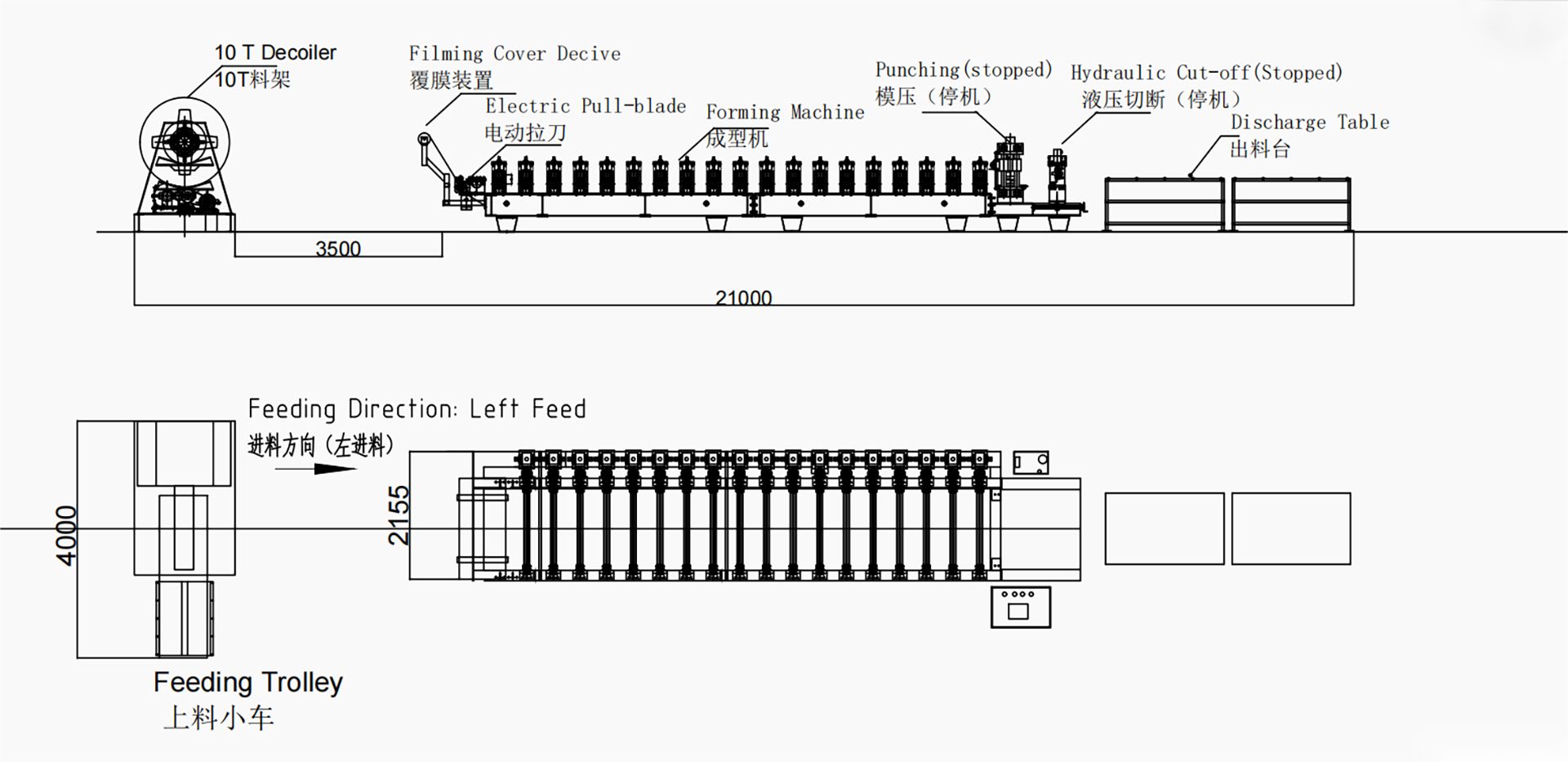
Automatic Uncoiling → Guided Feeding → Protective Film Application → Electric Pre-cutter → Roll Forming (19 Stations) → Press Forming → Cutting → Discharge
Process Step Description
Automatic Uncoiling Hydraulic or umbrella-type uncoiler supports the metal coil and ensures stable material feeding.
Guided Feeding Left and right guide rollers ensure precise alignment; independent manual screw adjustments for both sides.
Protective Film Application Rubber rollers apply protective film smoothly onto the steel sheet to prevent surface scratches.
Electric Pre-cutter Performs precise pre-cutting to ensure accuracy in subsequent press forming and final cutting stages.
Roll Forming 19-station precision roll forming using chrome-plated 45# steel rollers; gradually forms the curved corrugations and bamboo-like textures characteristic of antique-style glazed tiles; includes a small edge-folding process to prevent bulging at the sheet edges.
Press Forming Hydraulic cylinder drives the die up and down to press evenly spaced tile corrugations.
Cutting Fixed-length cutting with an accuracy of ±1.5mm.
Discharge Finished product output and orderly discharge.
V. Application Areas
Metal antique-style glazed tiles produced by this roll-forming equipment are widely used in the following sectors:
Antique-style architecture and cultural tourism projects: Covered walkways, pavilions, roofs in historic districts, Huizhou-style architecture, tourist attractions, garden structures, and other antique-style buildings.
Villas and high-end residences: Privately built rural villas and hotel villa roofing—featuring gracefully curved profiles that authentically replicate the appearance of traditional clay glazed tiles.
Urban "flat-to-pitched" roof renovation projects: Roof conversions in urban renewal—these lightweight yet high-strength metal tiles are ideal for pitched-roof buildings utilizing light-gauge steel, concrete, or timber structures.
Public and commercial buildings: Exhibition halls, resorts, hotels, schools, hospitals, shopping malls, convention centers, and sports venues.
Industrial and agricultural buildings: Garden-style factories, steel-structure farm complexes, and industrial workshops.
Religious and historical/cultural buildings: Temples, Taoist shrines, and other religious structures—where the rustic, elegant aesthetic blends seamlessly with the atmosphere of religious architecture.
VI. Market Outlook
Driven by the continuous development of the global architectural decoration industry, the market for antique-style glazed tiles is experiencing steady growth.
Booming Cultural Tourism and Antique-Style Architecture: The cultural tourism industry has flourished in recent years, leading to a surge in projects such as the restoration of ancient buildings, the creation of antique-style districts, and the development of cultural tourism towns. Metal antique-style tiles—characterized by their light weight (approximately one-tenth the weight of traditional clay tiles), high strength, excellent waterproofing, and ease of installation—are increasingly replacing traditional clay glazed tiles and resin tiles.
Urban Renewal and Flat-to-Pitched Roof Conversion Projects: As urban renewal and the renovation of older residential communities progress, there is a growing demand for lightweight, aesthetically pleasing, and weather-resistant metal antique-style tiles for flat-to-pitched roof conversion projects.
"Beautiful Countryside" Construction: New rural development initiatives have created strong demand for antique-style roofing materials; the "828-model" antique-style glazed tile, in particular, is widely used for roofing on self-built rural homes.
Growth in the Roll-Forming Equipment Market: Global sales in the metal sheet roll-forming machine market reached $576 million in 2025 and are projected to hit $760 million by 2032. The market size for tile-forming machines grew by approximately 8% year-on-year in 2025, with high-speed, continuous roll-forming machines emerging as the mainstream choice.
Technological Upgrades and Smart Trends: Equipment is evolving toward greater intelligence. Smart control modules enable remote management and 24-hour online diagnostics. The market penetration of fully automated, intelligent antique-style glazed tile production equipment continues to rise.
VII. Service & Support
Solution Design: Personalized equipment selection and production line layout based on customer product drawings, capacity requirements, and target markets.
Custom Manufacturing: Support for non-standard customization—including profile shapes, optional laminating systems, and material collection racks—with full control over the entire process from roll design to machine fabrication.
Installation & Commissioning: On-site installation, commissioning, and operator training provided by engineers to ensure rapid production startup.
After-Sales Support: Long-term technical consultation and spare parts supply; engineers hold valid visas and are available for on-site service worldwide.
Continuous Optimization: Equipment modification and capacity upgrade services available to adapt to changing production needs.
VIII. Why Choose Us
Nearly 20 Years of Manufacturing Experience: Mature technology, refined processes, and reliable quality.
Multi-Profile Capability: One machine handles multiple profiles (e.g., 800, 828, 840, 860, 1050 series), eliminating the need for repeated investment.
Cast-Iron Stands & Gearbox Drive: Features 19 cast-iron stands and 18 gearboxes, ensuring high rigidity, precision, and durability.
High-Strength Frame: Constructed from 400×200 H-beams and 25mm steel plate; precision-machined on gantry machining centers.
Protective Film Application: Rubber-roller laminating device effectively prevents surface scratches, preserving the finish's gloss and color integrity.
High-Precision Manufacturing: CNC-machined rollers ensure minimal radial and circular runout.
Edge-Folding Process: Includes an edge-folding step to prevent bulging at the panel edges, resulting in a flat, aesthetically pleasing finish.
High Speed & Efficiency: Forming speeds of 15–25 m/min; the entire line can be operated by a single person.
Intelligent Control: Fully automated PLC system, Siemens servo motors, and touchscreen interface.
Direct Manufacturer: No middlemen; excellent cost-performance ratio.
Global Service Network: Engineers hold all necessary visas; rapid response times.
 English